Copy with pride: What you can learn from other companies’ innovation programs

Every year, Forbes and Fast Company reveal their lists for the most innovative companies. These awards often get people in the non-listed organizations wondering – “How do they do it?” “What are they doing that I’m not?” Or worse – “I’m doing a lot of things like them, why aren’t we up there?” The super-status bestowed upon these companies creates lots of inspiration for trying out new techniques to promote innovation (typically followed by lots of googling and article reading).
Copy and pasting other companies’ innovation methods is not as quick of a fix as one would hope. Think back to when “Idea Boxes” (similar to “suggestion boxes”) first emerged. On the surface, it’s a great concept. And the truth is, its underlying promise still rings true: Anyone can submit ideas. Everyone is invited to take part. But the reality for many companies that tried to implement idea boxes as literally just idea boxes was that it left them with mixed feelings and more stuff on their plate to sift through.
Innovation is not a one-size-fits-all. You have to make sure efforts are customized to your company’s goals, resources, and culture. And so as they say – before you copy from a company, walk a mile in their shoes. Then you will be able to copy them and have their shoes.
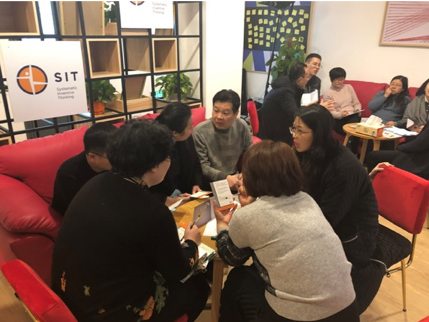
Jokes aside, in this day of networking, knowledge sharing, and even co-opetition, there are so many opportunities to investigate firsthand not only what other companies are doing, but how they actually do it. From embarking on an Innovation Journey to another country or keeping it local and visiting companies nearby, there’s much to learn from any organization whether or not they appear on the “Most Innovative List” (they’ll be flattered, trust me). The key here is having a personal interaction and seeing with your own eyes:
- New directions that you haven’t thought of – What is the most unique thing the company you visited is doing? It doesn’t have to be a huge, complex mechanism (although it can be). Look for the impact. Understand why it works for them. Did they need to make any adjustments along the way? What changes would you require if you adopted it in your company?
- What’s not working #1 – Think what you’d like to improve in your company’s innovation efforts and see if this is something your host company has struggled with as well. Have they found ways to overcome it? Is this something you could approach together and share insights?
- What’s not working #2 – Don’t forget to find out (diplomatically) what isn’t working for them. Make sure that you avoid those pitfalls in your company also.
- Validation for what is working – Is there something you’re proud of regarding how innovation runs in your company that might work well for your host company too? Based on your visits, are you able to gain confidence in how your company promotes innovation?
- Same same but different – Look for similarities in your innovation approaches. Do you share methods or innovation structures? Perhaps small differences can provide a helpful tweak.
- Knowledge sharing – Visiting companies offers new vantage points and exposure to knowledge accumulated by others. Traveling abroad provides unique insights that can result from having a different cultural outlook. Staying local offers opportunities for continued personal meet-ups, and ideas for resources you can partake in. You never know what might be going on in your own backyard. Regardless of visiting a company near or far, this is a game of give and take. Extend an invitation to meet back at your company. This will be the making of your own innovators’ network where you can all continue to learn with and from each other.
Getting your company to the “Innovation A-list” and sustaining the position over time is a process of implementing, fine-tuning, and evolving an array of techniques and mechanisms. Finding the right combinations for your company isn’t always a matter of reinventing the wheel, and certainly not successful if just replicated blindly. Get yourself out there, gather intel, and then renovate the wheel to work for you.


 Fast forward to today, innovation is now perceived as a culture and mindset; companies – from the long established to new startups – are seeking to instill it at all levels.
HR, given its role in the organization, is in a unique position to be a major enabler for establishing mechanisms so that a culture of creativity and entre/intra-preneurship will flourish.
Here are four ways HR can shape, frame, and facilitate a company-wide conversation about innovation:
1. Everyone is an innovator
“Accounting is a department. Marketing isn’t. Marketing is something everyone in your company is doing 24/7/365.” Jason Fried and David Heinemeier Hansson, Rework
Similar to marketing, companies have traditionally dedicated departments for innovation . Now, the expectation is for innovation to stem from anyone in any department. We, at SIT, define innovation as “thinking and acting differently in a useful way”. In this light, innovation is viewed as a valued improvement to a situational status quo; it is a way to perform your job better. It’s not tied solely to a company’s products and services, but also, and perhaps more importantly, to its productivity, operations, and processes. Adopting this outlook HR can help to ensure that its organization’s innovation agenda will promote an inclusive and empowering work culture.
2. Innovation Roles
Growing up, I loved pondering over the book “Cool Careers for Dummies”. The WEF states that by 2022, 75 million jobs will disappear while 133 million new ones will be created.
While we just established that ‘everyone is an innovator’, it is still necessary to have official innovation roles in place who are responsible for aggregating all the activities and outcomes.
We’re talking about Innovation Managers, Innovation Architects, Innovation Coaches, etc. Some of these may be full-time positions in their own right, while many companies prefer to assign these responsibilities to strong talent in the company, in addition to their current roles. HR can assist in determining and characterizing the roles needed, identifying individuals to assume official innovation positions, and defining the criteria to be assessed during the interview process.
Fast forward to today, innovation is now perceived as a culture and mindset; companies – from the long established to new startups – are seeking to instill it at all levels.
HR, given its role in the organization, is in a unique position to be a major enabler for establishing mechanisms so that a culture of creativity and entre/intra-preneurship will flourish.
Here are four ways HR can shape, frame, and facilitate a company-wide conversation about innovation:
1. Everyone is an innovator
“Accounting is a department. Marketing isn’t. Marketing is something everyone in your company is doing 24/7/365.” Jason Fried and David Heinemeier Hansson, Rework
Similar to marketing, companies have traditionally dedicated departments for innovation . Now, the expectation is for innovation to stem from anyone in any department. We, at SIT, define innovation as “thinking and acting differently in a useful way”. In this light, innovation is viewed as a valued improvement to a situational status quo; it is a way to perform your job better. It’s not tied solely to a company’s products and services, but also, and perhaps more importantly, to its productivity, operations, and processes. Adopting this outlook HR can help to ensure that its organization’s innovation agenda will promote an inclusive and empowering work culture.
2. Innovation Roles
Growing up, I loved pondering over the book “Cool Careers for Dummies”. The WEF states that by 2022, 75 million jobs will disappear while 133 million new ones will be created.
While we just established that ‘everyone is an innovator’, it is still necessary to have official innovation roles in place who are responsible for aggregating all the activities and outcomes.
We’re talking about Innovation Managers, Innovation Architects, Innovation Coaches, etc. Some of these may be full-time positions in their own right, while many companies prefer to assign these responsibilities to strong talent in the company, in addition to their current roles. HR can assist in determining and characterizing the roles needed, identifying individuals to assume official innovation positions, and defining the criteria to be assessed during the interview process.
 3. Personal Innovation Goals:
Declaring a culture of innovation and actually having people participate in it are two different things. There needs to be a system in place for monitoring innovation KPIs that cultivates a working environment where responsible risk-taking is encouraged. Including innovation activities in people’s yearly goals and then assessing them during performance reviews keeps the checks and balances in place to make innovation a reality.
4. Opportunities for Innovation: Gaining Skills and Putting Into Practice
HR and learning departments offer many opportunities for training, programs, and events that people can join. Many used to believe that creativity is a talent – you either have it or you don’t. And since creativity is an important element of innovation, the majority of people were never invited to the party. Today, we know better. Systematic creativity tools exist and people can be taught to innovate. More and more companies are promoting approaches like Lean Start-Up, Intrapreneurship, Hackathons, The “Google 20%”. Running training programs and then keeping employees accountable for using their new tools during these activities reinforces what has been learnt, proves to the individual that they really can use these tools in a useful way, and legitimizes participation in these activities – even if their direct manager doesn’t see its immediate relevance.
3. Personal Innovation Goals:
Declaring a culture of innovation and actually having people participate in it are two different things. There needs to be a system in place for monitoring innovation KPIs that cultivates a working environment where responsible risk-taking is encouraged. Including innovation activities in people’s yearly goals and then assessing them during performance reviews keeps the checks and balances in place to make innovation a reality.
4. Opportunities for Innovation: Gaining Skills and Putting Into Practice
HR and learning departments offer many opportunities for training, programs, and events that people can join. Many used to believe that creativity is a talent – you either have it or you don’t. And since creativity is an important element of innovation, the majority of people were never invited to the party. Today, we know better. Systematic creativity tools exist and people can be taught to innovate. More and more companies are promoting approaches like Lean Start-Up, Intrapreneurship, Hackathons, The “Google 20%”. Running training programs and then keeping employees accountable for using their new tools during these activities reinforces what has been learnt, proves to the individual that they really can use these tools in a useful way, and legitimizes participation in these activities – even if their direct manager doesn’t see its immediate relevance.
 HR has the mandate to nurture the culture of innovation by providing both the tools and the outlets in which innovation will serve the individual’s growth goals and the company’s business goals. It’s no secret that people want their ideas to be heard (and acted on!), and to feel they are constantly being challenged and moving ahead in the workplace. By HR adding an “innovation tab” to its activities, it will not only assist in drilling an agile mindset within the company, but help with employee retention and workplace satisfaction as well.
 implementing any strategy in the company, you’ve got to have leadership support at the forefront. Innovation strategies are no different. And while companies are, one after another, placing innovation at the top of their values and agenda, managers often experience a conflict of interest rolling out this strategy.

 to contribute to your project or encourage them to lead one of their own.